Obligated entities under Extended Producer Responsibility (EPR) are the stakeholders legally required to manage the end-of-life impact of the products they place on the market. These entities include producers, importers, brand owners, manufacturers, and plastic waste processors.
Introduction to EPR and Obligated Entities
The core principle of EPR is to assign clear accountability for waste management to the producers. The rules focus on the principal of “Polluters Pay”. This accountability imposed on the producers is implemented by mandating reporting of purchases of plastic packaging, computation of liability, meeting obligations through purchasing EPR credits and annual filing of requisite forms.
EPR Targets refer to the quantity of plastic packaging waste that needs to be either disposed or recycled by an obligated entity in a given financial year.
EPR obligations refer to specific responsibilities that need to be fulfilled by these obligated entities while fulfilling the EPR targets computed. These obligations are broadly classified as :
- End of life Disposal
- Obligation for minimum level of recycling
- Obligation for use of recycling content in plastic packaging
- Obligation to reuse plastic packaging content (applicable to brand owners)
Rule Reference to PWM Rules, 2016
- Rule 9: Extended Producer Responsibility of producers, Importers and Brand Owners
- Rule 13: Registration with CPCB/SPCB/PCC.
- Schedule II: EPR targets and obligations (introduced via 2022 amendment G.S.R. 321 E).
- CPCB SOP 2022 & 2023: Registration and compliance verification.
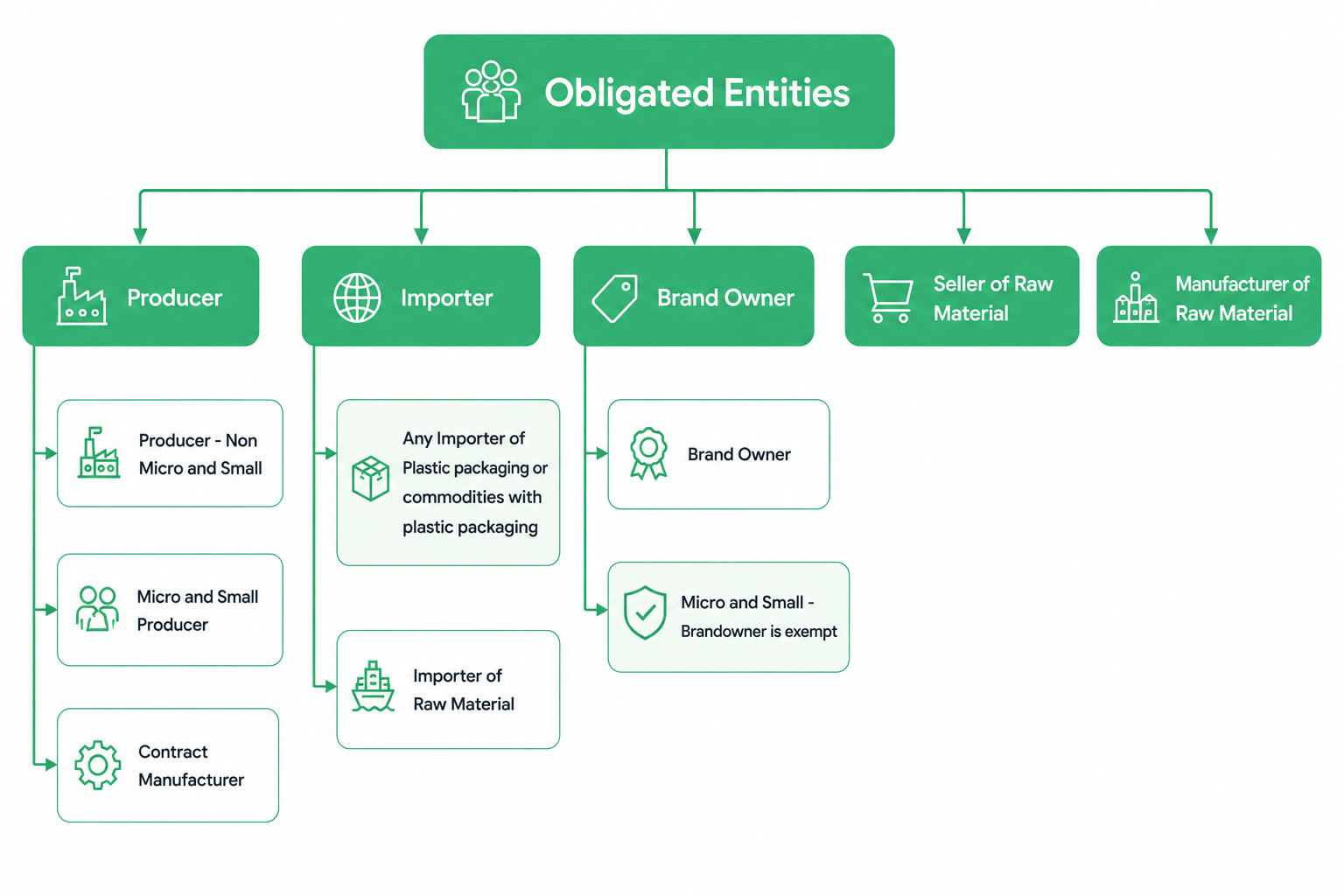
Obligated entities under the EPR Plastic waste management rules are primarily classified into – PIBO (Producer, Importer and Brand Owner) and SIMP (Seller, Importer, Manufacturer and Producers).
This classification is primarily based on :
a) their role in the plastic value chain and
b) their enterprise size (as per MSME criteria)
This categorization further enables determination of the registration route and compliance stringency.
“PIBO” as a category covers all entities that introduce plastic packaging into the Indian market, regardless of size, once they cross the MSME micro/small thresholds or otherwise fall under the main EPR Guidelines. In practice, PIBO includes:
- Producers/manufacturers of plastic packaging and, includes manufacturers of intermediate material used for manufacture of plastic packaging and also persons and entities engaged in the contract manufacturing of products using plastic packaging or through other similar arrangements.
- Importers of plastic packaging or products with plastic packaging.
- Brand owner means a person or company who sells any commodity under a registered brand label or trademark. It includes brand owners whose manufacturing is outsourced. However, all brand owners registered as micro and small entities under the MSME Act, 2006 are exempted from registration and compliance.
These entities must register as PIBO on the CPCB portal and meet full targets for offsets, reuse, and use of recycled content.
“SIMP” is a registration category for sellers/manufacturers/importers of raw materials and micro & small producers.
In brief, the obligated entities Under the EPR Framework are as under
Plastic Packing Producers – (Non-Micro and Small)
- Producers mean persons engaged in manufacture of plastic packaging; and, includes a person engaged in manufacture of intermediate material to be used for manufacturing plastic packaging,
- Responsibilities under EPR Rules:
- Registration on the centralized EPR portal maintained by CPCB. The registration has to be done separately for every manufacturing facility/ plant of the said producer and cannot be consolidated as a single registration on an entity level.
- Meet the offsetting targets mandated per the registration certificate/annual return category wise
- If a producer sells plastic raw material to a medium or small producer under the Micro, Small and Medium Enterprises Development Act, 2006 (MSME Act, 2006), the EPR obligation of that medium or small producer is required to be fulfilled by the plastic packaging producer who made the supply. However, The Extended Producer Responsibility target category-wise for such producer shall be excluding the sale made by such micro and small producers to Brand Owners and Producers, which are not categorized as micro and small enterprises as defined under the MSME Act, 2006.
- Ensure compliance with the minimum requirements of inclusion of recycled plastic content in the plastic packaging category wise.
- No producer shall on and after the expiry of a period of Six Months from the date of final publication of these rules in the Official Gazette manufacture or use any plastic or multi- layered packaging for packaging of commodities without registration from Central Pollution Control Board if operating in more than two states or union territories the concerned State Pollution Control Board or the Pollution Control Committees as per sub-rule of rule 13;
- Maintain a record of details of the person engaged in supply of plastic used as raw material to manufacture carry bags or plastic sheet or like or cover made of plastic sheet or multi-layered packaging plastic packaging
- Ensure submission of Annual return by the specified due date on the centralized portal maintained by CPCB.
- Marking and Labeling
- With effect from 1st July 2025, producers shall clearly label and provide the information specified under sub-rule (1) of Rule 11 in the following manner
- Provide a Bar code or a Quick Response code printed on the plastic packaging
- print on the plastics packaging the unique number issued under any law for the time being in force
- Inform the details of such Barcode and QR code to the CPCB
- With effect from 1st July 2025, producers shall clearly label and provide the information specified under sub-rule (1) of Rule 11 in the following manner
- Each recycled plastic packaging or commodity shall conform to the Indian Standard: IS 14534: 2023 titled ‘Plastics—Recovery and Recycling of Plastics Waste—Guidelines’, and shall bear the label and marking as shown below indicating the use of recycled plastic content in accordance with the said standard, and shall also comply with the applicable marking and labelling requirements specified by the Food Safety and Standards Authority of India, in respect of food contact application.”.
- Computation of obligations: Computation of Gross Annual waste generated i.e. Target for Producers of plastic packaging
| Average weight of Plastic Packaging sold in the last 2 financial years (in tons) | (A) |
| Add: Average quantity of pre-consumer plastic packaging waste (in tons) for last 2 financial years | (B) |
| Less: the annual quantity supplied to registered PIBO (tons) | (C) |
| Obligation | (A + B - C) |
Note: Export quantities shall be reported separately but excluded from EPR target computation, as they do not generate plastic waste within the country
In case the target arrives at a negative number, it is taken as zero and cannot be caried forward to be offset the subsequent year. From the FY 2023-24 100% of targets must be met.
The minimum level of recycling ( a excluding end of life disposal) of plastic packaging waste (as% of extended producer liability target) is outlined in the table below
| Category of Plastic Packaging | 2025-26 | 2026-27 | 2027-28 Onwards |
| Category I | 60% | 70% | 80% |
| Category II | 40% | 50% | 60% |
| Category III | 40% | 50% | 60% |
| Category IV | 60% | 70% | 80% |
The remainder of the EPR Target is to be met by End of Life (EOL) credits.
For example, of the total target for category I, an obligated entity would have to fulfill with at least 50% of recycled content and the remainder by EOL credits. Only those plastics, which cannot be recycled are to be sent for end-of-life disposal such as road construction, waste to energy, waste to oil, cement kilns (for co processing) etc. as per relevant guidelines issued by Indian Road Congress or Central Pollution Control Board from time to time.
Computation of Minimum use of Recycled Plastic Content (UREP)
It is mandatory for the producers to use recycled plastic content while MANFACTURING or while BUYING NEW plastic packaging.
The minimum use of recycled plastic content as a % of total plastic packaging manufactured in a year category wise is given in the table below:
| Category of Plastic Packaging | 2025-26 | 2026-27 | 2027-28 Onwards |
| Category I | 40% | 50% | 60% |
| Category II | 10% | 20% | 20% |
| Category III | 5% | 10% | 10% |
The producer can incorporate the recycled plastic in new plastic packaging manufactured by purchasing recycled raw materials having recycled plastic content. Alternatively, the producers can purchase plastic packaging containing recycled plastic.
However, mere purchase and is not sufficient for meeting the obligations, the producer has to ensure that the trail of the purchase transaction is uploaded by the seller of such recycled plastic raw material or plastic packaging on the CPCB portal.
Once the seller of such recycled plastic uploads the sale transaction in the CPCB Portal, it would automatically sit into the producers’ procurement data base. Therefore, the producers can purchase such recycled plastic content only from entities registered on the CPCB portal.
Prohibition of use of UREP in plastic packaging by any other law in the time being in force does not provide any immunity to producers under EPR to meet the UREP obligations computed and such exemption need to be supported with proper documents.
In case producers are unable to meet the UREP targets by incorporating recycled content in their plastic packaging, they will have to meet the obligation by purchasing certificates from PIBOs having excess UREP fulfillments.
The mechanism for exchange and purchase of certificate is being developed by CPCB.
With respect to Urep targets of FY 24-25 such targets can be Carry-forward for 3 Years with minimum target compliance of 1/3rd for each year. Businesses can fulfil targets earlier but cannot defer 100% of the targets up to the third year.
Checklist for registration and return filing
For a producer to register on the EPR portal, following documents are required:
- Company’s PAN
- Company’s GST Certificate
- Company’s Certificate of Incorporation
- Udhayam Registration certificate
- Authorized persons’ PAN
- Authorized persons’ Mobile number
- Authorized persons’ Email ID
- Authorized persons’ Designation
- Last month EB Bill soft Copy
- Fire license or safety certificate or Safety PDF
Producers of Plastic Packaging – (Micro and Small )
The extended producer responsibility of producers, which are micro and small producers as defined under the Micro, Small and Medium Enterprises Development Act, 2006 (27 of 2006), hereinafter referred to as micro and small producers, shall be fulfilled by manufacturer or importer of plastic raw material who has supplied the plastic raw material to such micro and small producers.
Provided that the target for use of recycled plastic content shall be fulfilled by such producers.
This implies that any producer defined above who is registered as a Micro or a small enterprise under the MSME Act, 2006 enjoys benefits in the form of exemption from obligations of offsetting and use of recycled plastic under the EPR Plastic Packaging Rules, 2016.
The producer, which is a micro or small enterprise, shall however be liable to declare category of plastic packaging manufactured by it on the centralized online portal. Therefore, they are required to register and file returns in the CPCB portal. The registration has to be done through the SIMP section in the CPCB portal.
However, its is to be noted that such Producers are not exempt from the obligation of meeting the minimum level of recycling.
The minimum use of recycled plastic content as a % of total plastic packaging manufactured in a year category wise is given in the table below:
| Category of Plastic Packaging | 2025-26 | 2026-27 | 2027-28 Onwards |
| Category I | 40% | 50% | 60% |
| Category II | 10% | 20% | 20% |
| Category III | 5% | 10% | 10% |
The producer can incorporate the recycled plastic in new plastic packaging manufactured by purchasing recycled raw materials having recycled plastic content. Alternatively, the producers can purchase plastic packaging containing recycled plastic.
However, mere purchase and is not sufficient for meeting the obligations, the producer has to ensure that the trail of the purchase transaction is uploaded by the seller of such recycled plastic raw material or plastic packaging on the CPCB portal.
Once the seller of such recycled plastic uploads the sale transaction in the CPCB Portal, it would automatically sit into the producers’ procurement data base. Therefore, the producers can purchase such recycled plastic content only from entities registered on the CPCB portal.
Prohibition of use of UREP in plastic packaging by any other law in the time being in force does not provide any immunity to producers under EPR to meet the UREP obligations computed and such exemption need to be supported with proper documents.
In case producers are unable to meet the UREP targets by incorporating recycled content in their plastic packaging, they will have to meet the obligation by purchasing certificates from PIBOs having excess UREP fulfillments.
The mechanism for exchange and purchase of certificate is being developed by CPCB.
With respect to Urep targets of FY 24-25 such targets can be Carry-forward for 3 Years with minimum target compliance of 1/3rd for each year. Businesses can fulfil targets earlier but cannot defer 100% of the targets up to the third year.
Packaging Producer - Contract Manufacturer:
Producer (Contract Manufacturer) means any person engaged in contract manufacturing of products using plastic packaging or through other similar arrangements for a brand owners. This is pursuant to the amendment in March 2024 amendment of the PWM Rules.
Under India's EPR framework for plastic waste management, contract manufacturers producing goods for brand owners are not directly responsible for EPR compliance; instead, the primary responsibility lies with the brand owner who owns the trademark for the product.
Responsibilities of Contract Manufacturer:
- Contract manufacturers must register as a producer under PIBO category if they are categorsied as Micro or Small enterprises under the MSME Act,2006, then they would be liable to register under SIMP category in the centralised EPR portal maintained by CPCB.
- Their obligations are calculated in the same manner as that of Producers (non- Micro and Small).
- They are required to file returns providing accurate data about quantities of products/plastic packaging supplied to brand owners by 30th June of the succeeding Financial Year or in accordance with the extended due dates specified.
- If a contract manufacturer also markets products under its own brand, then it must separately register as a brand owner, with direct EPR obligations for those products.
- Computation of obligations:
- Offset Target
| Average weight of Plastic Packaging sold in the last 2 financial years (in tons) | (A) |
| Add: Average quantity of pre-consumer plastic packaging waste (in tons) for last 2 financial years | (B) |
| Less: the annual quantity supplied to registered PIBO (tons) | (C) |
| Obligation | (A + B - C) |
Note: Export quantities shall be reported separately but excluded from EPR target computation, as they do not generate plastic waste within the country
In case the target arrives at a negative number, it is taken as zero and cannot be caried forward to be offset the subsequent year. From the FY 2023-24 100% of targets must be met.
The minimum level of recycling ( a excluding end of life disposal) of plastic packaging waste (as% of extended producer liability target) is outlined in the table below:
|
Category of plastic Packaging |
2025-26 |
2026-27 |
2027-28 Onwards |
|
Category I |
60% |
70% |
80% |
|
Category II |
40% |
50% |
60% |
|
Category III |
40% |
50% |
60% |
|
Category IV |
60% |
70% |
80% |
For the sake of clarity, In case the Contract manufacturer sells to an unregistered entity, the responsibility of meeting the obligations rests with the contract manufacturer itself.
The remainder of the EPR Target is to be met by End of Life (EOL) credits.
For example, of the total target for category I an obligated entity would have to fulfill with at least 50% of recycled content and the remainder by EOL credits. Only those plastics, which cannot be recycled are to be sent for end of life disposal such as road construction, waste to energy, waste to oil, cement kilns (for co processing) etc. as per relevant guidelines issued by Indian Road Congress or Central Pollution Control Board from time to time.
It is mandatory for the producers to use recycled plastic content while MANFACTURING or while BUYING NEW plastic packaging.
The minimum use of recycled plastic content as a % of total plastic packaging manufactured in a year category wise is given in the table below:
|
Category
of plastic Packaging |
2025-26 |
2026-27 |
2027-28 Onwards |
|
Category
I |
40% |
50% |
60% |
|
Category
II |
10% |
20% |
20% |
|
Category
III |
5% |
10% |
10% |
The producer can incorporate the recycled plastic in new plastic packaging manufactured by purchasing recycled raw materials having recycled plastic content. Alternatively, the producers can purchase plastic packaging containing recycled plastic.
However, mere purchase and is not sufficient for meeting the obligations, the producer has to ensure that the trail of the purchase transaction is uploaded by the seller of such recycled plastic raw material or plastic packaging on the CPCB portal. Once the seller of such recycled plastic uploads the sale transaction in the CPCB Portal, it would automatically sit into the producers’ procurement data base. Therefore, the producers can purchase such recycled plastic content only from entities registered on the CPCB portal.
Prohibition of use of UREP in plastic packaging by any other law in the time being in force does not provide any immunity to producers under EPR to meet the UREP obligations computed and such exemption need to be supported with proper documents.
In case producers are unable to meet the UREP targets by incorporating recycled content in their plastic packaging, they will have to meet the obligation by purchasing certificates from PIBOs having excess UREP fulfillments.
The mechanism for exchange and purchase of certificate is being developed by CPCB.
With respect to Urep targets of FY 24-25 such targets can be Carry-forward for 3 Years with minimum target compliance of 1/3rd for each year. Businesses can fulfil targets earlier but cannot defer 100% of the targets up to the third year.
Importers – under PIBO
Importers are entities that bring into India any kind of plastic packaging or any commodity with plastic packaging, or carry bags, plastic sheets, or similar materials for commercial use. i.e. Importers of ready plastic packaging or commodities with plastic packaging are covered under PIBO.
Responsibilities:
- Registration on the centralized EPR portal maintained by CPCB. Further, CBIC Instruction No. 21/2025-Customs dated 02.07.2025 mandates the Customs department to verify EPR registration on the CPCB plastic EPR portal before clearing goods that are plastic packaging consignments or have any kind of plastic packaging.
- There is no volume or, size or financial threshold exemptions available to importers. To Clarify ANY person importing ANY quantity of plastic packaging or commodity with plastic packaging is required to register on the CPCB EPR Portal.
- They are required to file returns providing accurate data about quantities of products/plastic packaging supplied to brand owners by 30th June of the succeeding financial Year or in accordance with the extended due dates specified.
- The Importers are required to meet the targets mandated per the registration certificate/annual return (category wise for offsets, use of recycled plastics)
- Computation of obligations:
- Offset Target
| Average weight of Plastic Packaging imported in the last 2 financial years (in tons) | (A) |
| Add: Average quantity of pre-consumer plastic packaging waste (in tons) for last 2 financial years | (B) |
| Less: the annual quantity supplied to registered PIBO (tons) | (C) |
| Obligation | (A + B - C) |
Note: Export quantities shall be reported separately but excluded from EPR target computation, as they do not generate plastic waste within the country
In case the target arrives at a negative number, it taken as zero and cannot be caried forward to be offset the subsequent year. From the FY 2023-24 100% of targets have to be met.
The minimum level of recycling ( a excluding end of life disposal) of plastic packaging waste (as% of extended producer liability target) is outlined in the table below:
|
Category of plastic Packaging |
2025-26 |
2026-27 |
2027-28 Onwards |
|
Category I |
60% |
70% |
80% |
|
Category II |
40% |
50% |
60% |
|
Category III |
40% |
50% |
60% |
|
Category IV |
60% |
70% |
80% |
For example, of the total target for category I an obligated entity would have to fulfill with at least 50% of recycled content and the remainder by EOL credits. Only those plastics, which cannot be recycled are to be sent for end of life disposal such as road construction, waste to energy, waste to oil, cement kilns (for co processing) etc. as per relevant guidelines issued by Indian Road Congress or Central Pollution Control Board from time to time.
Computation of Minimum use of recycles Plastic Content (UREP)
The minimum use of recycled plastic content as a % of total plastic packaging imported in a year category wise is given in the table below:
|
Category
of plastic Packaging |
2025-26 |
2026-27 |
2027-28 Onwards |
|
Category
I |
40% |
50% |
60% |
|
Category
II |
10% |
20% |
20% |
|
Category
III |
5% |
10% |
10% |
Any recycled plastic used in imported material does not account towards fulfillment of UREP obligation. In cases where the importer is unable to meet the UREP Obligations, the importer will have to fulfill the target by purchasing certificates from PIBOs having excess UREP. The mechanism for such exchange and purchase of certificate is being developed by CPCB.
It is pertinent that the importers purchase such certificates only from Registrered persons so that the same is duly reflected in the CPCB EPR portal in their registered account.
Importers – of Raw Material
An importer who imports plastic raw materials — including resins, pellets, or intermediate materials intended for manufacturing plastic packaging such as films, preforms, etc.—is classified as an Importer under SIMP i.e. Importers of raw materials used to manufacture plastic packaging are covered under SIMP.
Registration on the centralized EPR portal maintained by CPCB. Further, CBIC Instruction No. 21/2025-Customs dated 02.07.2025 mandates the Customs department to verify EPR registration on the CPCB plastic EPR portal before clearing goods that constitute as raw materials for the manufacture of plastic packaging. If this raw material imports itself come in any kind of plastic packaging, then the importer needs to register under PIBO and SIMP categories separately.
The plastic packaging imported to be declared under the PIBO registration and the volume of the resins imported needs to be reported under the SIMP registration.
Responsibility:
- Registration on the centralized EPR portal maintained by CPCB. Further, CBIC Instruction No. 21/2025-Customs dated 02.07.2025 mandates the Customs department to verify EPR registration on the CPCB plastic EPR portal before clearing goods that are plastic packaging consignments or have any kind of plastic packaging.
- Annual filing of requisite returns on the CPCB Portal.
- The obligation and offset of targets lie with the Importer and has to be duly complied with before filing of the annual return
If an importer sells plastic raw material to a medium or small producer under the Micro, Small and Medium Enterprises Development Act, 2006 (MSME Act, 2006), the EPR obligation of that medium or small producer is required to be fulfilled by the plastic packaging importer who made the supply. However, The Extended Producer Responsibility target category-wise for such producer shall be excluding the sale made by such micro and small producers to Brand Owners and Producers, which are not categorized as micro and small enterprises as defined under the MSME Act, 2006.
Brand Owners
A Brand owner is a person or a company, including retailers, supermarkets, or online platforms, which sell goods under a registered brand label or trademark.
These are the Entities that sell their products under their own brand, either manufactured or contracted from other parties.
- Obligations:
- Registration with EPR regulatory agency (e.g., CPCB in India).
- Maintenance and submission of accurate data required in the Annual return before the due date. This data includes details of plastic packaging purchased/ procured, produced, packaging contained in goods imported, sold and exported.
- Ensuring collection, recycling, and environmentally sound disposal of post-consumer products under their brand name.
- Computation of obligations:
- Offset Target
| Average weight of virgin plastic packaging (category wise) purchased and introduced in the market in the last 2 financial years (in tons) | (A) |
| Add: Average quantity of pre-consumer plastic packaging waste (in tons) for last 2 financial years | (B) |
| Obligation | (A + B) |
From the FY 2023-24 100% of targets have to be met.
Note: Export quantities shall be reported separately but excluded from EPR target computation, as they do not generate plastic waste within the country
Brand Owners using Category I (rigid) plastic packaging for their products shall have minimum obligation as % of Category I rigid plastic packaging in products sold annually to reuse such packaging as given below:
|
S. No |
Year |
Target (% of Category I rigid plastic
packaging in products sold annually) |
|
A |
Category I
rigid plastic packaging with volume/weight ≥ 0.9L/kg and < 4.9L/kg |
|
|
1 |
2025–26 |
10 |
|
2 |
2026–27 |
15 |
|
3 |
2027–28 |
20 |
|
4 |
2028–29 and
onwards |
25 |
|
B |
Category I
rigid plastic packaging with volume/weight ≥ 4.9L/kg used for drinking water |
|
|
1 |
2025–26 |
70 |
|
2 |
2026–27 |
75 |
|
3 |
2027–28 |
80 |
|
4 |
2028–29 and
onwards |
85 |
|
C |
Category I
rigid plastic packaging with volume/weight ≥ 4.9L/kg used for products other
than drinking water |
|
|
1 |
2025–26 |
10 |
|
2 |
2026–27 |
10 |
|
3 |
2027–28 |
15 |
|
4 |
2028–29 and
onwards |
15 |
Provided that the reuse of Category I rigid plastic packaging in food contact applications shall be subject to regulation of Food Safety and Standards Authority of India.
The quantity of rigid packaging reused by brand Owner shall be calculated by reducing virgin plastic packaging manufactured/purchased in that year from the sales of the Brand Owner.
Computation of Minimum use of recycled Plastic Content (UREP)
The Brand Owner shall ensure use of recycled plastic in plastic packaging, category wise, as given below namely:
Mandatory use of recycled plastic in plastic packaging. (% of manufactured plastic for the year)
| Category of Plastic Packaging | 2025-26 | 2026-27 |
2027-28 Onwards |
| Category I | 40% | 50% | 60% |
| Category II | 10% | 20% | 20% |
| Category III | 5% | 10% | 10% |
In cases where the brand owner is unable to meet the UREP Obligations, the brand owner will have to fulfill the target by purchasing certificates from PIBOs having excess UREP. The mechanism for such exchange and purchase of certificate is being developed by CPCB.
It is pertinent that the brand owners purchase such certificates only from Registrered persons so that the same is duly reflected in the CPCB EPR portal in their registered account.
In case, where Brand Owner is also Producer and/or Importer of plastic packaging material, the brand owner shall compute Extended Producer Responsibility targets and obligations as Producer and /or Importer, respectively as well in addition to the target computation as a brand owner.
Manufacturers
Manufacturers include entities producing both finished products or packaging material, which may either be sold under their own brand or supplied to other companies.
- Definition: Any company engaged in producing goods or products subject to EPR requirements.
- Obligations:
- Register on the centralized EPR system.
- Submit annual/quarterly returns on production volumes.
According to Rule 4(1)(e) A manufacturer must not sell, provide or arrange plastic to be used as raw material to any producer who does not have a valid registration from the concerned State Pollution Control Board (SPCB) or Pollution Control Committee (PCC).
Recyclers and Plastic Waste Processors
Recyclers and plastic waste processors are entities engaged in collecting, sorting, and recycling end-of-life regulated products. Companies involved in the mechanical or chemical conversion of post-consumer waste into raw material for new products.
- Obligations:
- All plastic waste processors have to register with concerned State Pollution Control Board or Pollution Control Committee and also on the centralized portal developed by Central Pollution Control Board.
- The Plastic waste processors shall submit annual returns after end of every financial year by 30th April of the next financial year on the quantity of plastic waste processed category-wise as per prescribed form in the CPCB Portal.
- Comply with operational standards and environmental safety criteria.
Challenges and Emerging Trends
As EPR regulations evolve, obligated entities face several emerging challenges and trends:
Increasing Scope and Complexity
- Expansion of regulated products (e.g., inclusion of new packaging materials, etc.)
- Rising targets for recycled content and required collection rates.
Integration Across Supply Chains
- Stakeholders must align production, import, sales, and recycling strategies across increasingly integrated supply chains.
- They also have to ensure that all the entities in their supply chain are registered entities.
Technological Advancements
- Utilization of digital portals for traceability, data management, and reporting.
- Adoption of innovative recycling technologies and closed-loop systems.
International Harmonization
- Alignment of EPR frameworks with international standards and cross-border rules is becoming paramount for multinational entities.
Tabular Summary: Obligated Entities and EPR Responsibilities
| Entity | Definition | Key Obligations | Registration Required? | Reporting Frequency |
|---|---|---|---|---|
| Producer | Manufactures plastic packaging and intermediate materials for sale. | Recycling, end-of-life disposal, reporting, and meeting UREP requirements. | Yes | Annual |
| Producer (Medium & Small) | Producers classified under the MSME Development Act, 2006. | Declare plastic packaging category and meet UREP requirements. | Yes | Annual |
| Producer (Contract Manufacturer) | Manufactures products using plastic packaging on behalf of brand owners. | Recycling, end-of-life disposal, reporting, and meeting UREP requirements. | Yes | Annual |
| Importer | Imports ready plastic packaging or commodities packed in plastic packaging. | Record keeping, compliance, recycling targets, end-of-life disposal, and UREP requirements. | Yes | Annual |
| Importer – Raw Materials | Imports plastic raw materials such as resins, pellets, films, and preforms. | Record keeping, compliance, recycling targets, end-of-life disposal, and UREP requirements. | Yes | Annual |
| Brand Owner | Sells products under its own label that are manufactured, imported, or contract-manufactured. | Record keeping, compliance, recycling targets, end-of-life disposal, and UREP requirements. | Yes | Annual |
| Brand Owner – Micro & Small | Brand owners classified as Micro or Small enterprises under the MSME Act. | Exempt from EPR obligations. | No | NA |
Summary:
Obligated entities are at the heart of Extended Producer Responsibility regimes, shaping the environmental outcome of regulated products from inception to end-of-life. Their legal duties are broadly anchored in registration, reporting, data disclosure, compliance with collection and recycling targets, and financing waste management. As global and national regulatory landscapes advance, the sophistication, scope, and enforcement of EPR mechanisms continue to expand, requiring proactive integration and compliance from all obligated entities.
For comprehensive compliance, each entity must align its processes, systems, and reporting mechanisms with sectoral EPR requirements. Leveraging collective frameworks such as PROs, digital portals, and industry initiatives can facilitate compliance and promote circularity. The future of EPR will increasingly demand coordination, transparency, and innovation from obligated entities, ensuring sustainability not just as a regulatory mandate but as a strategic business imperative.